B8M
F21M
KX250 / KX125
KX125SR
KLX250
KDX175
KX80
KX125
KX500
KX125SR
KX250SR
KDX200R / KDX200SR
KLX250R / KLX250SR
KX250SR
KX125SR
KX250F
KX450F
KX450F / KX250F
KX450F-SR
KX450
KX450X / KX250X
KLX230 / KLX230SM / KLX230Rs
KX250
KX450
Kawasaki's motocross activities began in 1963 and picked up pace as the years went on. In 1973, the first "Built to Win" lime green KX motocross machine broke cover. For the half century since then development has continued unabated year after year, and many race victories have been achieved.
Today, the KX's DNA can even be found in Kawasaki’s off-road models.
B8M
F21M
KX250 / KX125
KX125SR
KLX250
KDX175
KX80
KX125
KX500
KX125SR
KX250SR
KDX200R / KDX200SR
KLX250R / KLX250SR
KX250SR
KX125SR
KX250F
KX450F
KX450F / KX250F
KX450F-SR
KX450
KX450X / KX250X
KLX230 / KLX230SM / KLX230Rs
KX250
KX450
B8M
Kawasaki's first motocross machine was the B8M, which was based on the B8, a 125cc practical-use bike. Before it was released, Kawasaki’s in-house team entered the MFJ race held in Aonogahara, Japan, where they swept the top six places on a modified B8. At the time, Kawasaki Aircraft Industries was at a crossroads, trying to decide whether or not to continue with their struggling motorcycle business, but the B8's success gave the brand a boost in popularity and encouraged its continued challenge. The production B8M’s red fuel tank became a symbol of Kawasaki until the debut of the KX.
F21M
This was Kawasaki’s first 250cc production motocross machine. It featured a 21-inch front tyre at a time when 18-inch front and rear tyres were the norm. The bike had a good balance between engine performance and chassis rigidity, and featured rotary disc valves, a double-cradle frame with an underloop and Ceriani forks. In the recently-established All Japan Motocross Championship, Kawasaki factory rider Takashi Yamamoto won the 250cc title two seasons in a row in 1967 and 1968.
KX250 / KX125
The KX250 and KX125 were the first production motocross machines to officially feature the Lime Green colour. The 125 was equipped with rotary disc valves while the 250 featured piston valves. With the kind of volume for the expansion chamber only possible with a down-chamber design, the engine’s high output and strong torque were well received. When sales first started in 1973, they were named the 250MX and 125MX, but their model names, KX250 and KX125, were the same as the factory race machines. From 1975 onward, the names were changed to KX250 and KX125, marking the start of the KX series.
KX125SR
In 1979, Kawasaki introduced the Uni Trak suspension on factory racebikes around the world. This photo shows a KX125SR designed for the AMA. The early model pushrods were round steel pipes rising from the bridge that joined the left and right sides of the swingarm and meeting at the bellcrank at the top to form an inverted “V” shape. The rear fender featured integrated side number plates, which went on to be used on late model production KXs, although the one on this factory racebike was test-fitted with FRP.
KLX250
The 1979 KLX250 was an enduro machine with a KL250 (dual-purpose) air-cooled OHC 2-valve engine mounted in a KX125 chassis. Customers loved it for its mild, easy-to-use power characteristics, which were thanks to larger-diameter carburettor and intake and exhaust valves, in addition to a newly designed exhaust system. Compared to the more racing-oriented two-strokes of the time, models with four-stroke engines were seen more as play bikes. This bike featured an I-beam aluminium swingarm and had an impressive 250 mm front and rear wheel travel.
KDX175s
A string of two-stroke machines debuted beginning with the 1979 KDX400, and as two-strokes became a new category, it was the 1980 KDX175 that went on to become a bestseller. It later evolved into the KDX200 and formed the core of a Kawasaki line-up that also included the KDX80, KDX250 and KDX450. Initially air-cooled engines were standard because in desert conditions the availability of water was not guaranteed, but eventually liquid-cooled engines were adopted for the high-performance KDX series.
KX80
The original 1979 KX80 model had twin rear shocks, but with a rapid development pace that included minor changes twice a year, the 1981 KX80 model featured Kawasaki’s Uni Trak suspension. It was considered the ideal machine for parents to enjoy motocross together with their children and became popular for this reason. This popularity, along with the subsequent establishment of Team Green, led to the KX80 becoming a huge hit across the United States. Entries for the Ponca City (NMA Grand National) event aimed at amateur riders were soon mostly made up of KX80s.
KX125
The 1982 KX125 was released during a tumultuous period when it was normal for models to receive full model changes every year. It was loaded with new technology including the first front disc brake on a production motocrosser, a liquid-cooled engine, the latest evolution of Uni Trak rear suspension, a gold-anodised aluminium swingarm, and a rear fender with integrated number plate, among others. For that reason, it is still considered one of the most iconic Kawasaki models in the brand’s long history. The KX125’s large overall size—with a 300 mm front and rear wheel travel—set the standard for many machines to follow in the 1980s.
KX500
Kawasaki had fielded the KX400, KX420 and KX450 in open-class racing, but when the maximum allowed displacement was raised to 500cc in 1983, it led to the creation of the KX500. AMA National 500 champions on Kawasaki's monster machines included Brad Lackey, Jimmy Weinert, Jeff Ward, Mike Kidlawski and Mike LaRocco. Cancelled in 1993, the 500 class only lasted 10 years, but in the final years of its existence Lime Green went on a rampage.
KX125SR
AMA National Motocross triple-crown (125/250/500) winner Jeff Ward clinched his first title on this KX125SR in 1984. That season, Kawasaki sent the first engine with KIPS to the USA mid-season during a close battle for the lead, which eventually helped Ward win the title. The machine had many elements that showed Kawasaki’s ingenuity, including an asymmetrical design that featured a single vertical radiator on the left side, a cool air intake with a duct that went through the aluminium fuel tank, and others.
KX250SR
This is the KX250SR that Atsushi Okabe rode on his way to winning the 1989 All Japan Motocross 250cc title. Instead of the single backbone design that had been used until that time, it featured a new perimeter frame made up of two square pipes. This model and its new technology caused a sensation in the motocross world as a clear embodiment of how Kawasaki had continuously led with groundbreaking technology. The perimeter frame was featured on the production KX250 and KX125 from the following model year, 1990, and went on the to become the foundation for the aluminium frames of today.
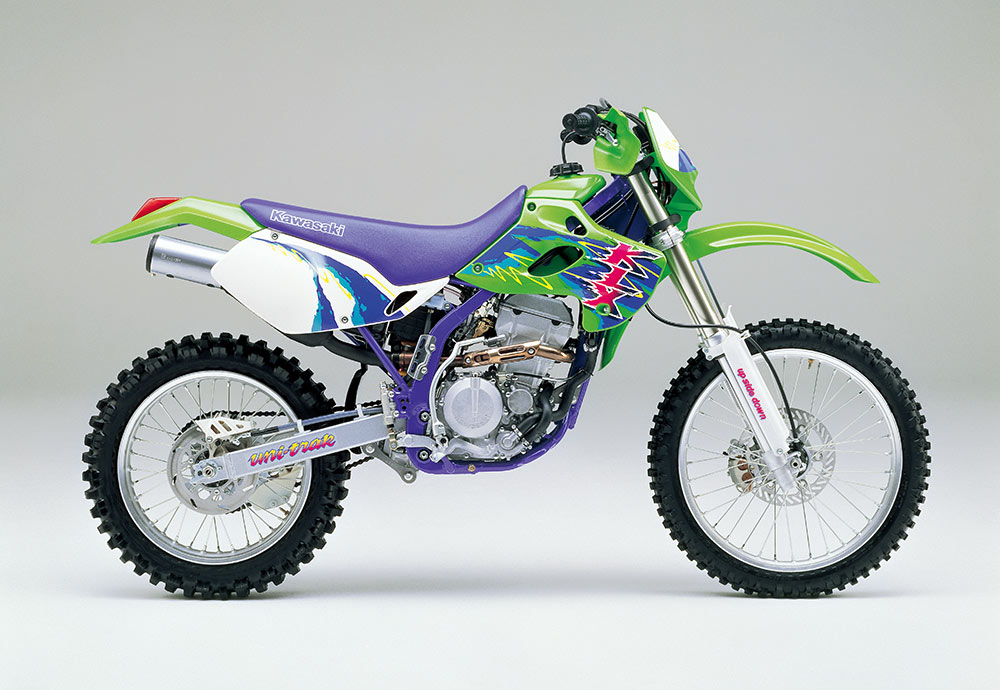
KDX200R / KDX200SR
The air-cooled-engine KDX200 enduro model underwent a full model change to be reborn as the KDX200R (racing specification) and KDX200SR (street specification). The landmark change that these two models represented marked the start of Kawasaki developing enduro and dual-purpose models alongside each other. The KDX220R/KDX220SR and KDX250R/KDX250SR were later built on the same concept and became quite popular as customers responded well to Kawasaki’s focus on racing.
KLX250R / KLX250SR
Following the success of the KDX series, the 4-stroke KLX250R (racing specification) and KLX250SR (street specification) models were released. Kawasaki's off-road vehicle lineup was now complete with both two- and four-strokes featured. The high-spec KLX was a huge hit as a razor-sharp off-road racer, boasting a KX-like perimeter frame, slim and lightweight chassis, and a high-performance liquid-cooled DOHC 4-valve engine. The KLX250ES—equipped with an electric starter—was later added to the lineup.
KX250
Jeff Emig's 1997 KX250 was a production model modified to meet AMA regulations and was packed with Kawasaki's most cutting-edge technology at the time. The factory racebike’s features include forks with additional sub-chambers, and an engine with a modified intake/exhaust system. In 1997, Emig accomplished the feat of winning double titles, taking both the AMA Supercross and AMA National Motocross championships (the latter for the second year in a row).
KX125SR
In the 2002 Motocross World Championship, the Kawasaki Racing Team, led by Team Manager Jan de Groot, won the 125cc title thanks to Mikael Maschio’s strong riding. The KX125SR loaned to the team was an all-new model, with new body dimensions, a tapered swingarm, a forward leaning engine and a KIPS exhaust device. The four-stroke KX250F-SR debuted the following year in 2003, making the KX125SR the last great two-stroke to survive that period of rapid change.
KX250F
Kawasaki's first four-stroke motocross machine was developed jointly with Suzuki. Its ultra-short-stroke DOHC 4-valve engine, D-shaped cross-section perimeter frame and thorough weight reduction resulted in overall competitiveness surpassing two-stroke 125 machines. Before the debut of the 2004 KX250F production model, Tetsuya Mizoguchi rode the KX250F-SR to win the 2003 All Japan Motocross Championship season opener with a 1-1 finish. Mizoguchi and the KX250F-SR went on to take more wins and eventually the title for the season.
KX450F
As the four-stroke wave swept into the premier class, the 2006 KX450F debuted as Kawasaki’s new flagship model. Its newly developed DOHC engine squeezed out a maximum 56.4 PS at 8,500 rpm, giving it the performance needed to win. Alongside the KX250F, which also underwent a full model change that year, the KX450F featured an aluminium perimeter frame. Supercross and motocross racing at the time was a still a mix of two- and four-strokes, but as four-strokes had superior power and traction, it did not take long for them to fully take over the class.
KX450F / KX250F
In 2007, Kawasaki completed its first sweep of AMA Supercross titles with James Stewart winning SX on a KX450F, Ben Townley winning Lites East on a KX250F and Ryan Villopoto winning Lites West on a KX250F. Stewart on the KX450F was a dominant force, winning 13 out of 16 rounds to take the title in only the KX450F’s second year of competition, despite the new 450cc four-stroke only having debuted the year before in 2006.
KX450F-SR
Ryan Villopoto took the KX450F to four consecutive AMA Supercross titles between 2011 and 2014, and the 2014 machine is shown here. The machine suffix SR for “Special Racer” was added from 2014 onward. The bike made use of advanced technology to assist in finding setups for races, with stroke sensors in the suspension and a GPS mounted on the anodised upper triple clamp. Launch Control Mode was instrumental in getting holeshots and could be turned on or off at the rider's discretion.
KX450
Eli Tomac’s bike was based on the fully redesigned 2019 KX450. Tomac won three consecutive AMA Pro Motocross titles between 2017 and 2019 aboard the KX450F/KX450. The new engine replaced its kickstarter with an electric starter and featured an exhaust system equipped with a resonator. The suspension contained both KYB and SHOWA elements. The fork featured pressure sensors and the rear shock had a sensor to detect linkage angle, allowing its data to be analysed.
KX450X / KX250X
Based on the KX450 and KX250, these models were designed especially for cross-country racing, and to that end they featured 18-inch rear wheels and enduro tyres, while retaining the powerful engine and excellent ride quality that the KX450 and KX250 were already known for. The engine mapping, suspension, and brakes were tuned specifically for the cross-country models. Also included were a skid plate to protect the underside of the engine and a side stand, both of which were useful in cross-country riding situations.
KLX230 / KLX230R / KLX230SM
Sporting a new lightweight, air-cooled engine with ample torque, a high-tensile steel perimeter frame, and KX-inspired chassis design, the KLX230 dual-purpose model and KLX230R off-road model debuted for the 2020 model year. Evolving for 2023, the KLX230 featured a slimmer-design LED headlight unit, while the KLX230SM supermotard was added to the KLX series lineup to meet a wider range of user demands.
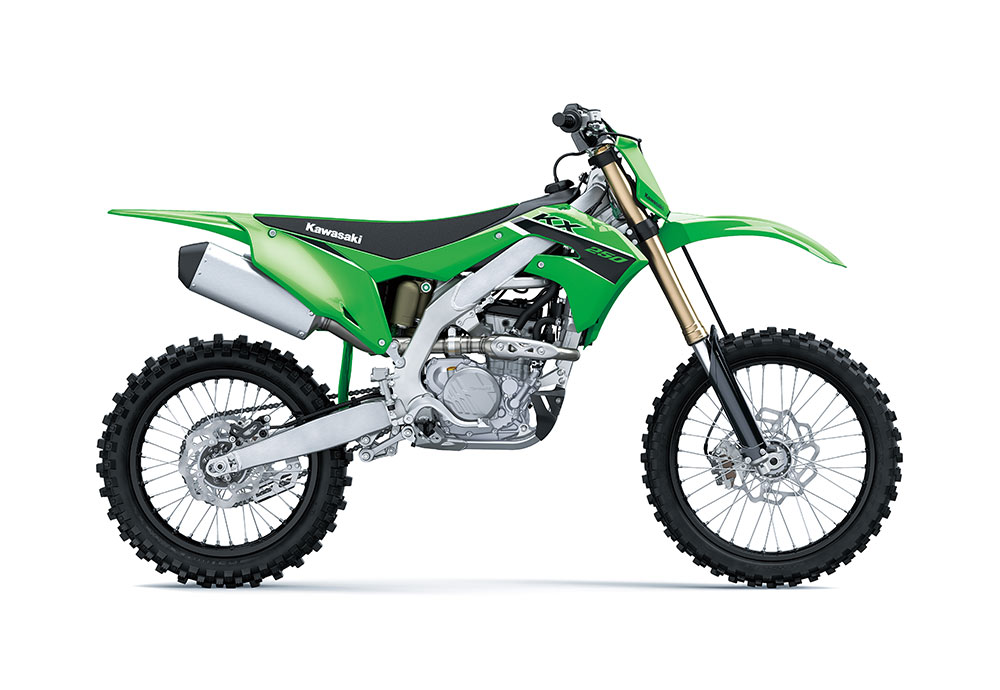
KX250
After major updates including a new engine with a finger follower rocker arm for the 2020 model year, then a new frame, hydraulic clutch, and electric start in the 2021 model year, the KX250 received even further improvements for 2023. The engine got more power throughout the rev range thanks to changes in the intake and exhaust systems, while optimised suspension settings and a wider rear tyre improved cornering and traction performance.
KX450
The KX450 was fully redesigned for 2024. Its standout feature was its updated engine, which featured optimised intake and exhaust flow for smooth power delivery in the low- to mid-rpm range and ample power at higher rpm. A new frame was adopted to suit the new engine, resulting in a machine with both light handling and a smooth character. This was also the first model in the KX series to feature Power Modes and Kawasaki TRaction Control (KTRC). In addition, with the "RIDEOLOGY THE APP KX" smartphone app, users could adjust the KX450’s engine maps directly from their smartphones.